
Finding Words
On inspiration, turning points, and resonance
Over the past few weeks, I thought I needed to find inspiration. Until I realized that it wasn’t about finding inspiration, but rather finding the words to express what actually inspires me. Words for what I’ve been feeling and thinking for a long time.
Do you know that feeling? You have these little snippets of thought that could make the world a little better—they’re pressing and pushing, trying to get out of you. But you can’t seem to turn them into even a single complete sentence? That’s how I’ve felt for a very long time. That’s why I’ve now decided to start writing anyway. And to hope that the words will come as I write.
But what exactly is this feeling that I just can’t find the words for right now? And when did it start?
I believe that we all have that feeling I’m talking about deep inside of us. We’ve just buried it deep beneath societal narratives and our own beliefs. For some, perhaps deeper; for others, not quite as deep. And then there are those moments in life that, despite all the noise above it, reconnect us with that feeling.
I believe that we all have that feeling I’m talking about deep inside of us. We’ve just buried it deep beneath societal narratives and our own beliefs. For some, perhaps deeper; for others, not quite as deep. And then there are those moments in life that, despite all the noise above it, reconnect us with that feeling.
Which moments were those for me?
One was when I read Vivian Dittmar’s ‘Echter Wohlstand’. I don’t know exactly when that was. I only know that we were still living in our old city apartment, overlooking the green city park, during the COVID-19 pandemic. It must have been shortly after the book was published in 2021. I remember sitting on our green sofa in the evening, looking at the green curtains, and how — in the midst of all the madness out there — the book gave me hope and sparked countless moments of resonance: ‘Yes, exactly!’ In her book, Vivian puts into words exactly what I feel and have felt. I don’t know how I came across the book. To be honest, the cover (pink, purple, and featuring a butterfly perched on one of the letters of the title) strikes me as a bit too cute for me to have picked it up in the bookstore or for the book to deserve, in my view—but those, too, are just societal attributions.
So what made me pick up the book anyway?
‘Echter Wohlstand’. 2021, the year the book was published, was a time when what I had believed in until then was slowly starting to fall apart. Thanks to the pandemic, the situation at my job had gotten even worse. Not only was I writing marketing copy that didn’t interest me at all and whose sole purpose was to sell something I saw no value in, but even did I lose the impression that anyone in the company was convinced these texts—which were, after all, produced under immense pressure from above —were truly important for actually selling the services that they were about.
So I was writing copy that existed solely so that someone “up there” could look good. And I was doing it alone at home—working remotely due to the pandemic—and without a team, which was barely accessible because of the high pressure, or had already left the company and wasn’t being replaced. To say “it didn’t feel right” would be an understatement. It made me sick. Most mornings, I’d open my laptop and could have burst into tears before I’d even opened my email inbox or glanced at the never-ending to-do list.
How did I end up here?
Fear. My life at that point—at least for the most part—was the result of many half-hearted compromises I’d made out of fear.
But where did that fear come from?
Since 2018, I’ve spent a lot of time unravling my own convictions and belief patterns—figuring out what they are and where they originated on my life’s journey. That’s a good thing, because it frees me somewhat. From my current perspective, however, I would certainly ask whether that’s even necessary, given that the real problem is actually a feeling that many of us have lost today—and one that was lost long before my individual beliefs took shape: the feeling of being carried by life, of being able to let oneself sink into the great web of things and trust that everything will be all right. The feeling that enables us to act not out of fear, but out of love. Fundamental trust in life. In German: ‘Ur-Vertrauen’.
… given that the real problem is actually a feeling that many of us have lost today—and one that was lost long before my individual beliefs took shape: the feeling of being carried by life, of being able to let oneself sink into the great web of things and trust that everything will be all right. The feeling that enables us to act not out of fear, but out of love. Fundamental trust in life. In German: ‘Ur-Vertrauen’.
‘Urvertrauen’. I’ll try to translate that into English.
But it seems that this is one of those words whose full meaning cannot be translated as such. You can split the German word “Urvertrauen” into two parts “Ur” and “Vertrauen” which means“trust”. But it’s not that easy to translate the “Ur” part into English. The best translation I could find was “primordial source” or “source of all life.” So “Urvertrauen” means something like “trust in the source of all life” or “primordial trust.” At the same time, there’s the German word “Ursprung,” which means roughly the same as “origin” in English.
On the way back from our last trip, we stopped in Alsace. On a hiking sign near our campsite, the word “Ursprung” (‘origin’) suddenly caught my eye. I resisted the urge to hike up the mountain for two hours with our 13-month-old son in his baby carrier in 26-degree heat just to see where the path to the “Ursprung” would lead us. After all, according to Google, “Ursprung” is simply a very small town in France. But what remains is the question: What is our origin? Ur-sprung. Where does the “Ur” spring from? This blog will also explore these questions surrounding the “Ur.” If my hope is fulfilled, I’ll eventually find the words to express it in the process. And somehow even translate them into English.
Back to Vivian Dittmar and her book ‘Echter Wohlstand’.
So there I was, sitting at my desk. In a job that was making me sick and, beyond that, wasn’t contributing anything meaningful to life. Out of fear—a fear somehow connected to my lack of connection to this mysterious “Ur” (Primordial). And a subsequent need for false security that had initially brought me to this point and was now preventing me from changing anything about it. Long story short: Shortly thereafter—perhaps through my work with my inner beliefs, perhaps simply because the cost of staying in that job was higher than the benefit—I managed to quit. Without knowing what was coming next. Getting out, taking a break, hitting the reset button. The path back to reconnecting with the Primordial came later.
Did Vivian Dittmar’s book play a part in that? Maybe.
After all, she managed to put into words something that, until then, had been just a feeling for me—and that completely contradicted the stories in my head: Prosperity—true prosperity—has nothing to do with a paycheck—money—that we can use to buy things. There is something else—or much more—than this material, financial prosperity that our current society so desperately craves. In her book, Vivian describes five dimensions of true prosperity: time prosperity, relationship prosperity, creativity prosperity, spiritual prosperity, and ecological prosperity. Explaining all of that would go beyond the scope of this post—for that, I recommend Vivian’s book. I think it’s enough, for the start, to let these five—let’s call them “dimensions of prosperity”— sink in. And, through them, nourish that feeling within us that we may all have lost touch with a little. A feeling that is still there, however, and that may be directly connected to the primordial, the ‘Ur’.
I’ve decided to set out on a journey.
I want to explore the topics this blog post touches on in greater depth. And I want to take you along on this journey. As I write, I realize that I’m finding more words to express this than I thought I would. That’s good.
This blog will address the following questions…
Where and why exactly have we lost our sense of primordial trust (the feeling of being cradled in the womb of Mother Earth)? How can we regain it (at least in part)?
What does it take to create a world that better serves life? And how can we, as human beings, (re)discover a way of life (a way of living and working) that preserves and regenerates more than it destroys?
What is our contribution as human beings in the grand scheme of things? And how can we, as individuals, find our own unique expression of it?
How can we live and work together in the future in a way that is good, secure, and life-serving?
I invite you to join me on my personal journey of understanding and on my path to living in relationship with nature in everyday life. This is something that, in my view, is directly connected to the questions I’ve just raised and may even be part of the answer.
I’m glad you’re here!
© Ramona Niehus, 2026
Sources and Recommendations:
This text was written entirely without AI and stems 100% from my own thoughts and feelings. It was co-created with the resonance of the primordial within me.
I made a conscious decision not to have this text corrected or “rewritten more elegantly” by AI. In an age where so many texts we encounter are written by AI—and are thus reproductions of past thoughts —I believe we need more authentic texts written by humans. So that we can truly reinvent the future.
For more insight, I recommend Vivian Dittmar’s book:
Vivian Dittmar, 2021: Echter Wohlstand. Warum sich die Investition in inneren Reichtum lohnt. Ein Plädoyer für neue Werte. Kailash Verlag, München.
Ramona Niehus | Waldsüchtig
Facilitator & Author
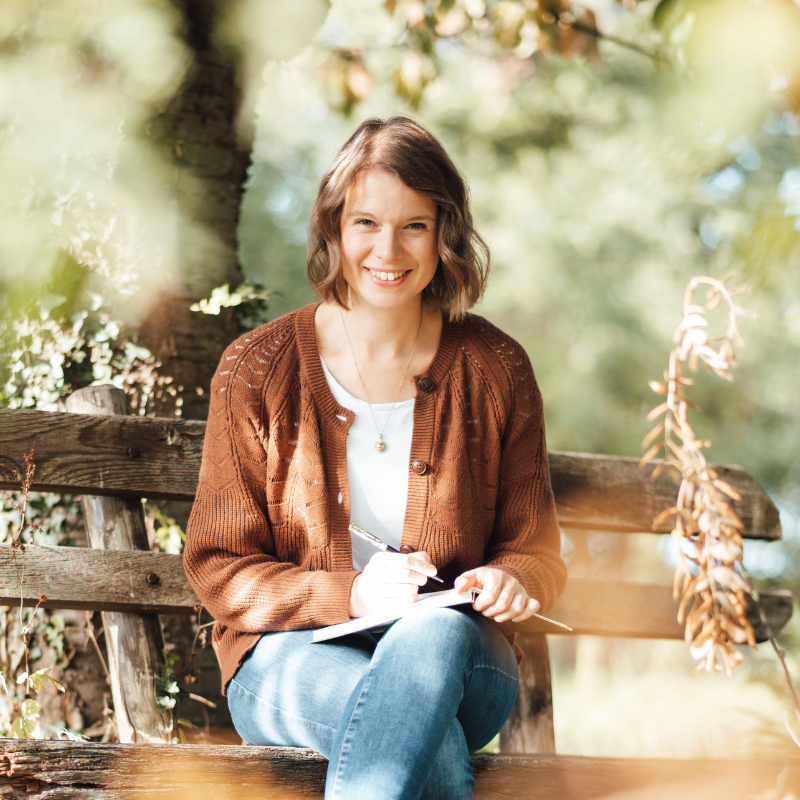
I’m Ramona, the woman behind Waldsüchtig. My blog is a space for reflection: How do we want to live in the future? In a time of ecological and social crises, how can we reconnect—with nature, with ourselves, and with one another?
Here you’ll find thoughts on reconnecting with nature and social change. An invitation to reflect and explore these ideas together. More about me.